Familiar Strangers: Why the People in Your Teen's Friends List May Not Be Who You Think
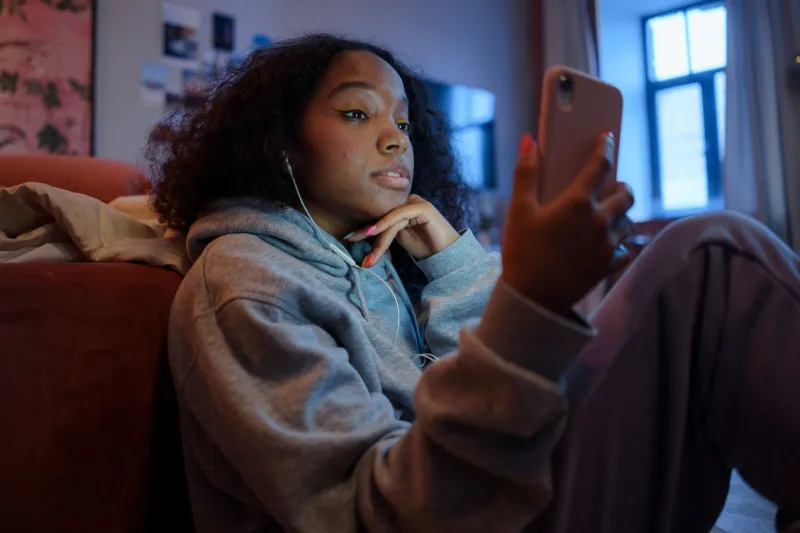
Most teenagers in America today have absorbed the concept of stranger danger. They have heard it in school hallways, from guidance counselors, and likely from their own parents at the kitchen table. Yet a significant number of those same teenagers will accept a friend request from someone they have never met in person — often without hesitation, and almost always with a ready explanation for why it is perfectly fine.
The disconnect is not a failure of intelligence. It is a failure of translation. The rules teens learned about strangers were written for the physical world, and the digital environment operates by an entirely different logic — one that predators understand far better than most parents do.
The Social Proof Problem
When a teen receives a friend request from an unfamiliar account, the first thing most of them check is not the profile's authenticity. They check the mutual connections. If a stranger shares five, ten, or fifteen friends with your child, the implicit message is clear: this person belongs to my world.
This is social proof, and it is one of the most powerful psychological mechanisms in human decision-making. Advertisers have used it for decades. Predators have adopted it with remarkable sophistication.
Creating a fake account populated with mutual connections is not technically difficult. A bad actor can send mass friend requests to students at a specific school, building a network of accepted connections over a matter of weeks. Once enough real teens have accepted, the account gains automatic credibility with every subsequent target. The mutual friends are real. The person behind the profile is not.
For many teens, the presence of those shared connections is the only verification they perform. The illusion of belonging to a shared social network is, in their reasoning, sufficient proof of trustworthiness.
Fake Credentials and the Legitimacy Illusion
Beyond mutual connections, predators frequently use what might be called credential layering — the construction of a profile that signals legitimacy through accumulated detail. A fake profile targeting high school students might include a plausible school affiliation, participation in a local sports team, photos drawn from another real person's public account, and a posting history that mirrors the interests of the intended audience.
The more specific the details, the more convincing the illusion. A profile that names a real Nashville-area high school, references a recent football game, and uses the right local slang will read as authentic to a teenager whose entire social context is that same environment. Teens are not checking whether the person's face matches a real student roster. They are pattern-matching against what a legitimate peer looks like — and a carefully built fake profile passes that test.
This is particularly concerning because teens often extend their verification process no further than a quick scroll through the profile. A few photos, a recognizable school name, and a comment from a real mutual friend can be enough.
The Gap Between Knowledge and Behavior
Research consistently shows that awareness of a risk does not reliably translate into protective behavior, particularly among adolescents whose developing brains are still calibrating social reward against potential threat. Teens know, abstractly, that not everyone online is who they claim to be. In the moment of receiving a friend request from someone who appears to fit their social world, that abstract knowledge competes with the very immediate social reward of expanding their network.
For many teens, declining a request also carries social risk. What if the person is real and mentions it to a mutual friend? What if they are judged as unfriendly or paranoid? The fear of social misstep frequently outweighs the more distant fear of digital danger.
Predators are aware of this calculus. Some will even use a light initial interaction — a comment on a post, a reaction to a story — to warm the connection before sending a formal request, making a refusal feel even more socially awkward.
What Parents Can Do Without Creating Shame
The goal of any conversation with a teenager about this subject should not be to make them feel foolish for the way they have managed their connections. Shame tends to drive behavior underground rather than change it. What works better is building a shared framework for thinking about digital discernment — one that acknowledges the genuine complexity of online relationships.
Start with curiosity, not interrogation. Rather than auditing your teen's friends list as a surveillance exercise, ask them to walk you through how they think about who they accept. What makes someone feel trustworthy to them online? You are likely to learn something about their reasoning, and they are likely to surface their own doubts in the process.
Introduce the concept of engineered familiarity. Explain, in plain terms, how mutual connections can be manufactured. Most teenagers find this genuinely surprising — not because they are naive, but because they have not had reason to consider it before. The mechanics of how a fake account builds credibility can be a compelling and eye-opening conversation.
Establish a simple personal policy together. Rather than imposing a blanket rule, work with your teen to define what they consider an acceptable basis for accepting a connection. Have they interacted with the person in real life? Can they name a specific context in which they know them? This gives teens a self-directed standard rather than a parental mandate.
Normalize the idea of ignoring requests. Many teens feel social pressure to respond to every request. Reinforcing that ignoring or declining an unknown account is a neutral, unremarkable act — not a social statement — can reduce the perceived cost of caution.
Check in periodically, not constantly. A monthly, low-pressure check-in about their online social landscape builds the habit of reflection without creating the feeling of surveillance that drives teens toward more hidden platforms.
The Larger Picture
A teenager's friends list is not merely a social record. It is a window into who has access to their posts, their location check-ins, their daily routines, and the candid moments they share without thinking twice about the audience. Every unfamiliar connection in that list represents a potential point of access to information your teen never intended to share with a stranger.
Building genuine digital discernment — the kind that holds up in the moment of a flattering friend request, not just in the abstract — is one of the most important things a family can invest in together. At Social Media Safety Nashville, we believe that investment begins not with monitoring software, but with the kind of honest, shame-free conversation that gives teenagers the tools to make better decisions on their own.